
Google’s Environmental Report Splits the AI Story in Two

source: Google
Google released its eleventh annual environmental report this week telling two stories at once. One is about the environmental cost of building AI infrastructure, where nearly every operational number moved up. The other is about AI as an environmental tool, where Google argues its models help other people cut emissions faster than Google is adding them. The company wants them read together, and how the second story is positioned turns out to matter as much as what it claims.
Most of the coverage led with the first story, the record electricity, water, and emissions, which is the reading Google’s own headline numbers invite. Google has built genuine operational strength and is now watching that strength get outpaced by the thing it is building.
The operational numbers went up, and Google says so plainly
Total electricity demand rose 37 percent in 2025, up from 27 percent the year before. Since 2019, Google’s electricity demand has increased by more than 250 percent. Water consumption reached 10.9 billion gallons, a 34 percent increase from 2024. The executive summary states directly that its AI infrastructure buildout is accelerating faster than the grid is decarbonizing, and that the path to its climate ambitions will not be linear.
The emissions picture is more split than the headlines suggest. Google reduced operational emissions by 2 percent year over year, a real achievement against 37 percent load growth. Supply chain emissions grew 25 percent, driven by the manufacturing of AI hardware and by an Asia-Pacific supplier base running on grids that remain short on carbon-free energy. Data center construction alone reached roughly 2.3 million tCO2e in 2025, about a fifth of Google’s total ambition-based scope 3 emissions. Supply chain is where the growth lives, and it is the category Google controls least, because the emissions are embedded in chips and servers before they ever reach a Google facility.
The efficiency gains are real, and the demand curve outruns them
Google’s data centers run at a 2025 fleet-wide average power usage effectiveness of 1.09, against an industry average that puts overhead energy use 83 percent higher. That is a durable engineering lead. The company also reports that its seventh-generation Ironwood TPU is nearly 30 times more power efficient than its first Cloud TPU from 2018, and that the energy and carbon footprint of the median Gemini text prompt fell by factors of 33 and 44 over a twelve-month period.
Those per-prompt and per-chip gains are impressive and also the source of the trap. Efficiency improves per unit while demand grows in aggregate. Google serves Gemini across fifteen products with half a billion users each, seven of them with two billion, and at that scale per-prompt gains get swamped by volume. The total footprint climbs even as every individual operation gets cleaner.
The AI-for-sustainability case is the report’s most interesting move
Google is placing its counterweight here, and the use cases separate by how much they actually prove.
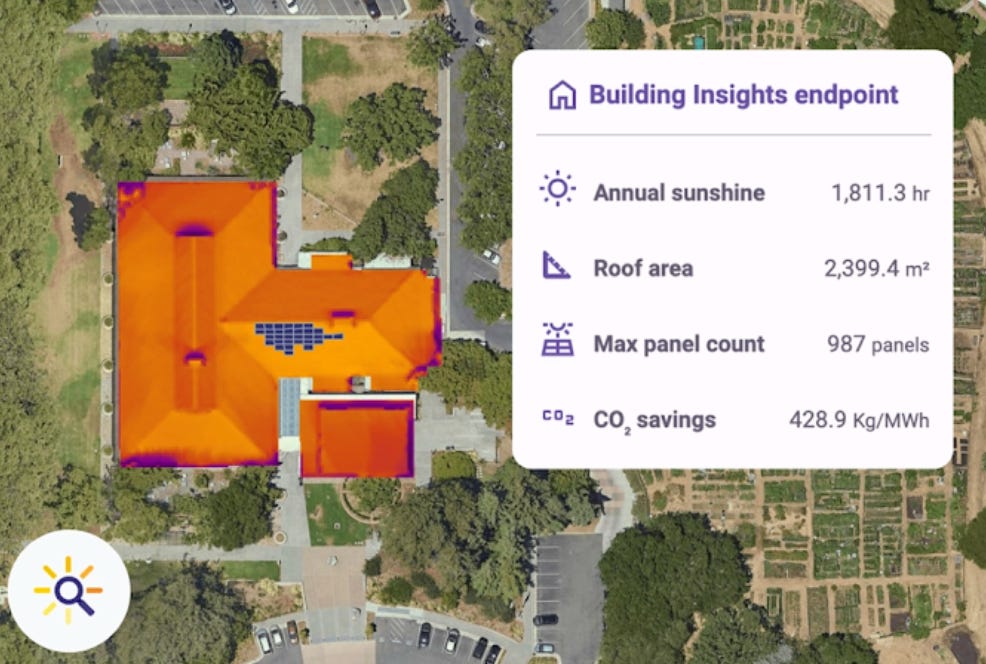
The headline claim is that nine Google products helped individuals, cities, and partners reduce an estimated 41 million tCO2e in 2025, which the report frames as roughly three times Google’s own emissions. The nine include fuel-efficient routing in Maps, Nest thermostats, Solar API, and Green Light. The mechanism is concrete, since fuel-efficient routing changes what millions of drivers actually do. The weakness sits in the accounting. Every figure is an enabled-emissions estimate built on a counterfactual, and those baselines are softer than a metered electricity bill. The report itself says the data has not been independently verified and that Google is still refining the methodologies.
The contrails work is the report’s strongest disclosure because Google shows both sides. The model that predicts contrail-forming flight conditions generated 380 tCO2e of compute while enabling an estimated 3,000 tCO2e in avoidance, roughly seven times its own footprint. Putting the compute cost next to the benefit is the standard the rest of the section should meet.
The adaptation cases are harder to score and arguably matter more. Google expanded AI flood forecasting to more than two billion people across around 150 countries, and its NeuralGCM model helped the Government of India send monsoon-onset forecasts to 38 million farmers. Its open-sourced SpeciesNet identifies more than 2,000 animal species from camera-trap images at above 94 percent accuracy. None of these reduce Google’s emissions, and Google does not claim they do. They make a different argument, that the societal value of the technology should factor into how its footprint is judged. That position is reasonable and resists measurement, which is the thing to hold onto when it sits alongside hard tonnage figures.
Where the AI-as-tool argument gets circular
The most revealing use cases are the ones where Google deploys AI to fix problems its own AI demand helped create. Tapestry, part of Alphabet’s X moonshot factory, built an agentic tool called HyperQ with PJM Interconnection that pre-screens the site-control portion of a generator’s interconnection submission in under ten minutes, targeting the queue delays that slow new clean energy onto the grid. Its GridAware platform increased one New Zealand utility’s grid visibility by 221 percent.
This is useful work aimed at the bottleneck Google’s own growth is making worse. Whether it helps more than the demand hurts is the question the report leaves open.
Read the report with the model it ships with
Google released the report with NotebookLM built in. You can query the document conversationally and get answers cited to direct quotes, text, and images from it, or listen to a podcast-style audio overview instead of reading past a hundred pages. Given the length, it is the more efficient way in.
The more interesting part sits behind the interface. Google used AI across the reporting process itself, testing Gemini to cross-check draft environmental claims against internal guidelines and using NotebookLM’s persona prompting to simulate scrutiny from skeptical journalists, investors, and NGOs before publication. It then open-sourced the whole method as a sustainability-reporting playbook other companies can adopt. The disclosure documenting AI’s environmental cost is also a working demonstration of the AI products that drive that cost.
What the report actually establishes
Google is doing close to everything a single company can do on the supply side. It signed more than 12 GW of net-new clean energy in 2025, its largest annual total ever and more than the prior two years combined. It replenished roughly 78 percent of its freshwater consumption across 165 watershed projects. It diverted 88 percent of data center operational waste from landfills. It is moving earlier than any peer into advanced nuclear, enhanced geothermal, fusion offtake, and hourly carbon-free energy matching. Amazon buys more clean energy in absolute terms, and has for years, though Google’s 24/7 carbon-free energy target holds it to a stricter standard than volume-based procurement, since it requires matching clean supply to demand hour by hour on each grid rather than buying enough annual credits to net out on paper.
The total footprint still grew, because demand is outrunning clean supply and the hardest emissions sit upstream in a supply chain Google can influence but not command. On the operational side, this is a company doing serious work and being honest about losing ground.
The AI-for-sustainability section reads differently once you notice what it is positioned to do. Google expanded it from five product solutions last year to nine this year, and gave it far more room in the report than the year-over-year emissions increase received. Some of the underlying work is strong. Fuel-efficient routing, contrails, and flood forecasting hold up on their own terms. The section’s job in the document is to answer a question the operational numbers raise, which is whether the AI buildout is worth its environmental cost. Presenting 41 million tCO2e of enabled reductions against Google’s own emissions is a way of answering yes.
That framing serves AI at least as much as it serves sustainability. The technology is under sustained criticism right now for exactly the resource demands this report documents, and a report that leads readers from record electricity and water use toward a story about AI solving climate problems elsewhere is doing more than accounting. It is building a case for the investment. The enabled-reductions figures are real estimates of real products, and they are also a rationale, offered by the company whose capital is committed to the buildout, at the moment that buildout most needs one. The sustainability claims may be sound. The reason they occupy this much of the report has as much to do with defending AI as with defending the climate.